Transition Years: 1992 -
1994
 1992
1992
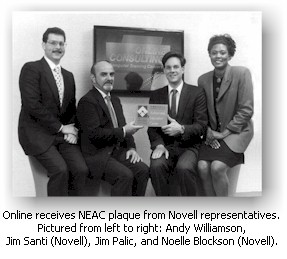
- Online became a Novell Authorized Education Center. This marked our entry
into the technology training market and our transition from our dependence on end-user
applications training. Today technology training accounts for about half of our training
business.
- In the preceding years we had added management structure with a training
manager, training sponsors (middle managers), a courseware development manager, project
sponsors (middle managers) and a sales manager. Eventually, as these individuals retired
or moved on to other jobs or different positions within the company, we didn’t
replace the positions. Nineteen ninety-two marked the peak of our experiment with
traditional hierarchical structures.
1993  This year we opened our Baltimore office, representing the high
water mark in our geographic expansion. In addition to Baltimore, we now had
training sites in New Jersey (Princeton and Somerset), Pennsylvania (Malvern and
Philadelphia), and Delaware (Wilmington and Newark). Seven locations in all!
Unfortunately, as larger companies increased their PC training demand, they established
in-house classroom facilities. Although Online held many classes at corporate
facilities, our own classrooms were under utilized. As a result, over the next five
years, we worked to consolidate our sites into two "mega" training locations—Philadelphia and Wilmington. This approach seemed more in sync with our market.
This year we opened our Baltimore office, representing the high
water mark in our geographic expansion. In addition to Baltimore, we now had
training sites in New Jersey (Princeton and Somerset), Pennsylvania (Malvern and
Philadelphia), and Delaware (Wilmington and Newark). Seven locations in all!
Unfortunately, as larger companies increased their PC training demand, they established
in-house classroom facilities. Although Online held many classes at corporate
facilities, our own classrooms were under utilized. As a result, over the next five
years, we worked to consolidate our sites into two "mega" training locations—Philadelphia and Wilmington. This approach seemed more in sync with our market.
 1994
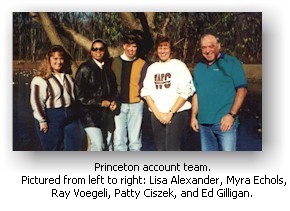
We experimented with various team structures.
(The Princeton account team, pictured right, was one of our first
experiments.) Although most of these initial team concepts were not adopted
by the company at that time, we did discover the need for a team approach to managing the
flow of information between our clients and our instructional staff. As a
result, we created a new "training liaison" position, which is still in
use today. A lead instructor is assigned to each new account as the liaison, and this
person works on start-up procedures for new accounts and acts to channel information
between our clients and our instructional staff.
Jim and Andy tried to present various strategic plans to the
organization. However, these plans never seemed to take off. They realized that Online
needed to learn a new way of planning and creating a shared vision of the future. Why was
it that their brand of shared vision ("Here’s the vision I came up with, now I
am sharing it with you") didn’t catch on? Online was missing a good
conceptual framework of how the organization should be run. In the following years
we began to learn how to do this better.
Summary: The Transition Years marked a departure from our
dependence on applications training, the end of our geographic expansion, and the end of a
traditional organizational hierarchy. At the same time, this period set the
stage for technology training, mega training centers in Wilmington and Philadelphia, and
innovative team-centered leadership.
1994
We experimented with various team structures.
(The Princeton account team, pictured right, was one of our first
experiments.) Although most of these initial team concepts were not adopted
by the company at that time, we did discover the need for a team approach to managing the
flow of information between our clients and our instructional staff. As a
result, we created a new "training liaison" position, which is still in
use today. A lead instructor is assigned to each new account as the liaison, and this
person works on start-up procedures for new accounts and acts to channel information
between our clients and our instructional staff.
Jim and Andy tried to present various strategic plans to the
organization. However, these plans never seemed to take off. They realized that Online
needed to learn a new way of planning and creating a shared vision of the future. Why was
it that their brand of shared vision ("Here’s the vision I came up with, now I
am sharing it with you") didn’t catch on? Online was missing a good
conceptual framework of how the organization should be run. In the following years
we began to learn how to do this better.
Summary: The Transition Years marked a departure from our
dependence on applications training, the end of our geographic expansion, and the end of a
traditional organizational hierarchy. At the same time, this period set the
stage for technology training, mega training centers in Wilmington and Philadelphia, and
innovative team-centered leadership.


Home
| Inside Online | History | Philosophy | Office
Tour | @ Work | Just for Fun |